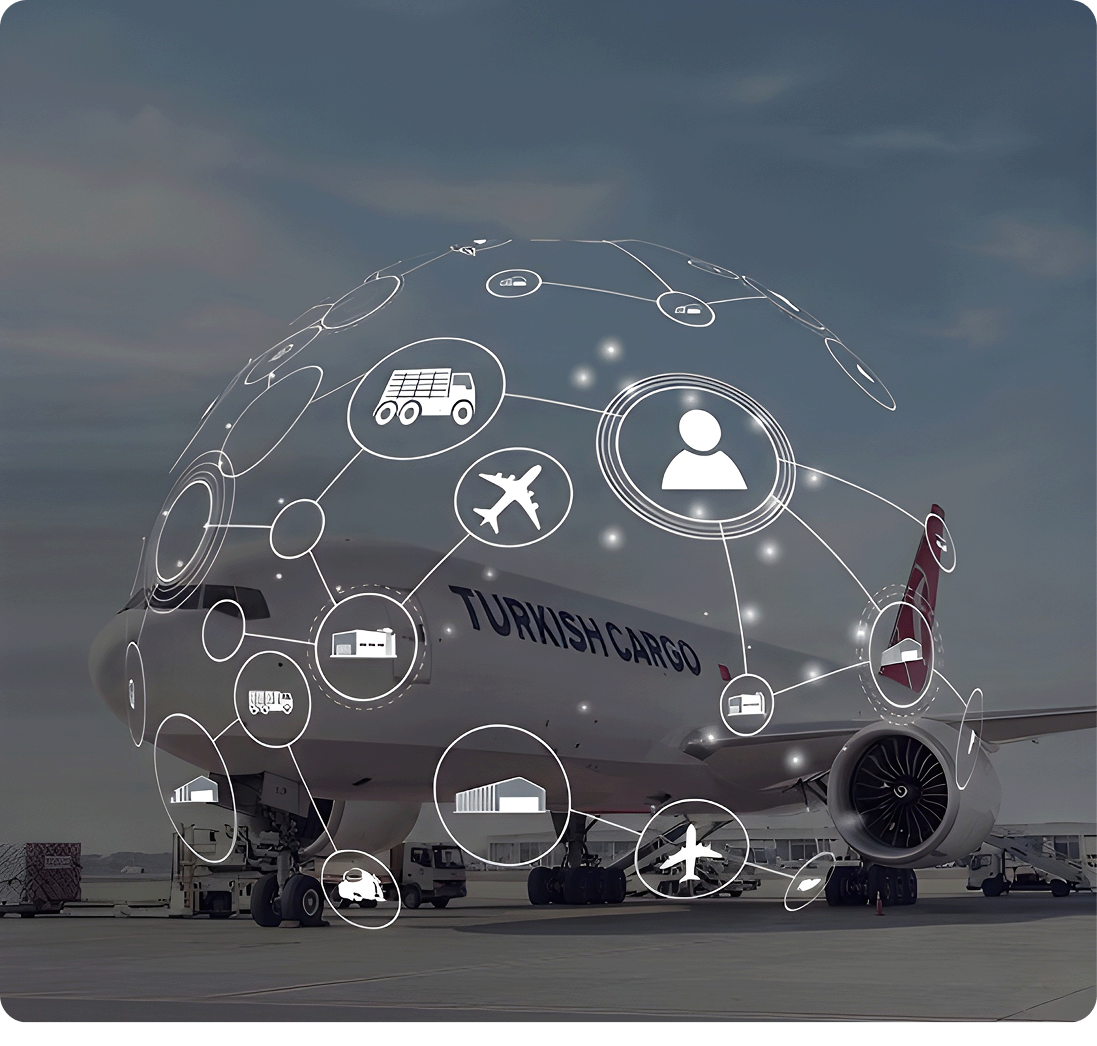
Digital Solutions
At Turkish Cargo, we are reshaping air cargo operations through our artificial intelligence and optimization solutions, process automation, and smart logistics systems.
Digital sales channels
Digital sales channels offer faster and more accessible sales and booking processes compared to traditional methods.
Explore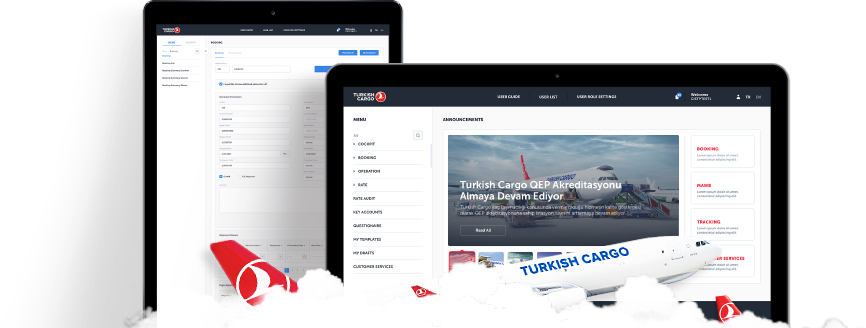
Artificial intelligence and optimization
With tools empowered by artificial intelligence and optimization, we accelerate customer interaction while transforming our planning and decision-making processes into data-driven structures. Our operations are now faster, smarter, and more sustainable.
Cargy – Your AI-powered digital assistant
Cargy is Turkish Cargo’s artificial intelligence–powered digital assistant.
End-to-end artificial intelligence in sales processes
This artificial intelligence–powered transformation initiative aims to digitalize our end-to-end pre-sales and post-sales communication processes, enabling faster, more consistent, and uninterrupted responses to customer requests
Route and tariff optimization
At Turkish Cargo, route, capacity, and tariff decisions are optimized through data-driven decision support mechanisms that jointly evaluate demand and operational constraints across all planning horizons—from short-term operational needs to seasonal planning.
Next-generation strategic data assistant
This assistant, powered by an advanced artificial intelligence infrastructure, enables Turkish Cargo users to query strategic data using natural language and access complex analyses within seconds.

Cargy – Your AI-powered digital assistant
Cargy is Turkish Cargo’s artificial intelligence–powered digital assistant. By providing fast and intelligent responses to our customers’ questions regarding shipments, flights, and operational processes 24/7, it facilitates easy access to information. With the practical experience it delivers across digital channels, it supports managing processes in a more effortless and efficient manner.
Objectives

A practical and digital solution experience for recurring questions

Rapid access to information related to shipment processes

Smooth interaction through real-time inquiries

Clear and natural communication through understandable responses
Benefits

Faster and smarter responses

24/7 accessible digital support

Time-saving, simple, and user-friendly experience

Single-point access to information

End-to-end artificial intelligence in sales processes
This artificial intelligence–powered transformation initiative aims to digitalize our end-to-end pre-sales and post-sales communication processes, enabling faster, more consistent, and uninterrupted responses to customer requests. An AI-assisted response process has been implemented for reservation requests submitted via email for general cargo shipments departing from Istanbul. In the initial phase of the project, reservation and pricing processes were prioritized, and the scope will be gradually expanded to cover different business scenarios and regions.
Objectives

Scalable digital infrastructure

Automation-focused processes
Benefits

Rapid customer response

Consistent and uninterrupted communication experience

Reduced operational workload

Route and tariff optimization
At Turkish Cargo, route, capacity, and tariff decisions are optimized through data-driven decision support mechanisms that jointly evaluate demand and operational constraints across all planning horizons—from short-term operational needs to seasonal planning. This structure enables balanced route selections by considering cost and capacity efficiency alongside carbon emission impacts through comparative and multi-criteria analyses of route and tariff scenarios, while contributing to the delivery of consistent tariffs and reliable capacity to customers.
Objectives

Balanced and data-driven tariff planning

Rapid alignment with market demand

Enhancing customer experience via AI-based satisfaction surveys during and after conversations

Offering a more personalized experience by diversifying service channels
Benefits

Fast and transparent decision-making process

Reduced dependency on manual workflows

Economic and environmental balance

Next-generation strategic data assistant
This assistant, powered by an advanced artificial intelligence infrastructure, enables Turkish Cargo users to query strategic data using natural language and access complex analyses within seconds. By transforming our corporate memory into real-time insights, the system significantly accelerates decision-making mechanisms and optimizes operational processes with a strong focus on customer satisfaction.
Objective

Centralized and intelligent access

Effective utilization of strategic data
Benefits

Operational agility

Rapid identification of customer and market dynamics
Process automation solutions
We digitalize and automate core operational processes to ensure standardized, traceable, and uninterrupted cargo operations across our global network.

RPA
Robotic Process Automation (RPA) enables high-volume, repetitive tasks traditionally dependent on manual labor to be performed by software robots.

IDP
Intelligent Document Processing (IDP) is a technology that enables high-volume documents received in various formats to be read, classified, and automatically transferred into systems using AI-based solutions. In the first IDP project, AWB documents are processed using IDP technology, enabling AWB-Execute operations through automation.
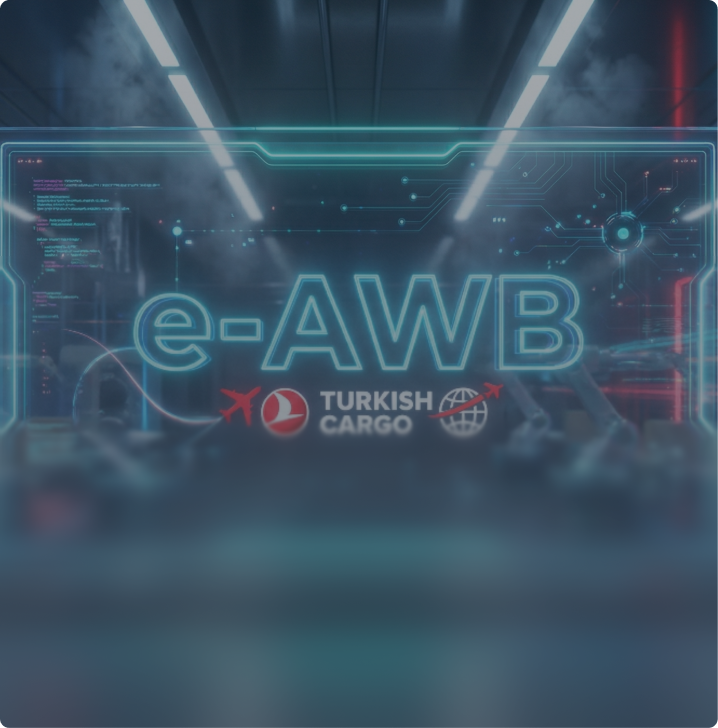
Digital cargo
Thanks to the e-AWB application, the shipping bill of lading is prepared digitally.

RPA
Robotic Process Automation (RPA) enables high-volume, repetitive tasks traditionally dependent on manual labor to be performed by software robots. The RPA project implemented within Turkish Cargo aims to standardize and digitalize business processes.
Objectives

Preventing human errors and reducing error-based risks

Increasing employee motivation

Redirecting employees toward analysis- and initiative-driven tasks
Benefits

68 processes have been deployed live, achieving a saving of 70 person/month through RPA.

IDP
This solution enables the creation of optimal 3D loading plans for shipments and ULDs. Loading schemes become clear, planning decisions are reinforced, and different scenarios can be easily evaluated. As a result, capacity is utilized more efficiently, flight planning is strengthened, and customers receive more consistent weight and load information.
Objectives

Enabling AI-based reading of high-volume documents in different formats

Automatically transferring extracted data into systems

Increasing process efficiency and reducing manual workload
Benefits

In the first phase, a total saving of 6 person/month is targeted in AWB-Execute operations.
Digital cargo
Electronics Concimento (e-AWB)
EAP: Used when paper documents accompany the shipment (e.g. pouch, consol manifest, etc.).
EAW: Used when no paper documents accompany the shipment.
e-AWB transition process:
- Signing the MeA with IATA: As a first step in the e-AWB process, the agent must sign a multilateral agreement (MeA) with IATA. For detailed information on the MeA, please visit the IATA website.
- System compatibility with e-AWB: The system must be capable of transmitting FWB messages in version 16 or 17, or shipment data must be entered via TK GO (Turkish Cargo Web Portal).
Depending on the shipment status, the special handling code “EAP” or “EAW” must be used within the FWB message.
Click here for e-AWB entry.
You can access a sample message for e-AWB shipments here. - High-quality message transmission: FWB messages must be transmitted to the airline system accurately, completely, and in a timely manner.
For further information regarding data quality, please contact digitalkargo@thy.com. - Activation notification: The airline initiates the e-AWB process by sending an activation notification to the agent via the IATA platform. .
Click here for frequently asked questions.
Single Process: Due to various reasons, e-AWB may not be applicable on certain routes. In such cases, parties should continue the transportation process by aligning the paper AWB with the electronic data in the system. Turkish Cargo supports the “single process” application at many of its stations.
Click here to access the Single Process flow diagram.
Electronic Cargo Security Declaration (E-CSD)
E-CSD refers to the electronic transmission of this declaration in message format to the relevant authorities.
E-CSD implementation stages:
- Prior to being delivered to the agent, the cargo is subjected to specific security measures by certified known consignors. This confirms that the shipment is secure enough for air cargo transportation.
- The CSD or e-CSD created by the known consignor is submitted to the agent, who then forwards the declaration and the cargo to the airline or Ground Handling Agent (GHA).
- The airline transmits the declaration to the destination station.

13KB
e-CSD Example
August 14, 2025
13KB
e-CSD Example
August 14, 2025
Smart logistics systems
By making technology a natural part of operations, we ensure that field operations become traceable, measurable, and manageable. With data-driven insights and digital solutions, we design more seamless and sustainable processes.
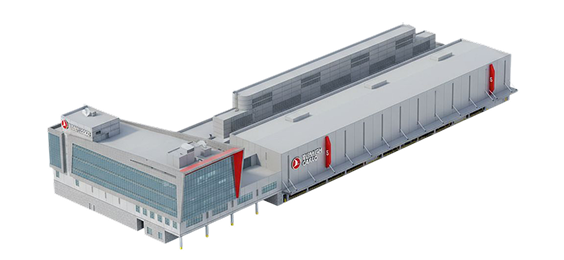

Projects
By making technology a natural part of operations, we ensure that field operations become traceable, measurable, and manageable. With data-driven insights and digital solutions, we design more seamless and sustainable processes.
Contour measurement (VOLUME)


Autonomous mobile robots (AMR)
3D ULD
01
Contour measurement (VOLUME)
This solution, operating via mobile devices, digitally creates cargo contour schemes using AR and LiDAR technologies.

02
Autonomous mobile robots (AMR)
Autonomous vehicles operating in warehouse and apron areas enhance operational quality, safety, flow, and predictability.

03
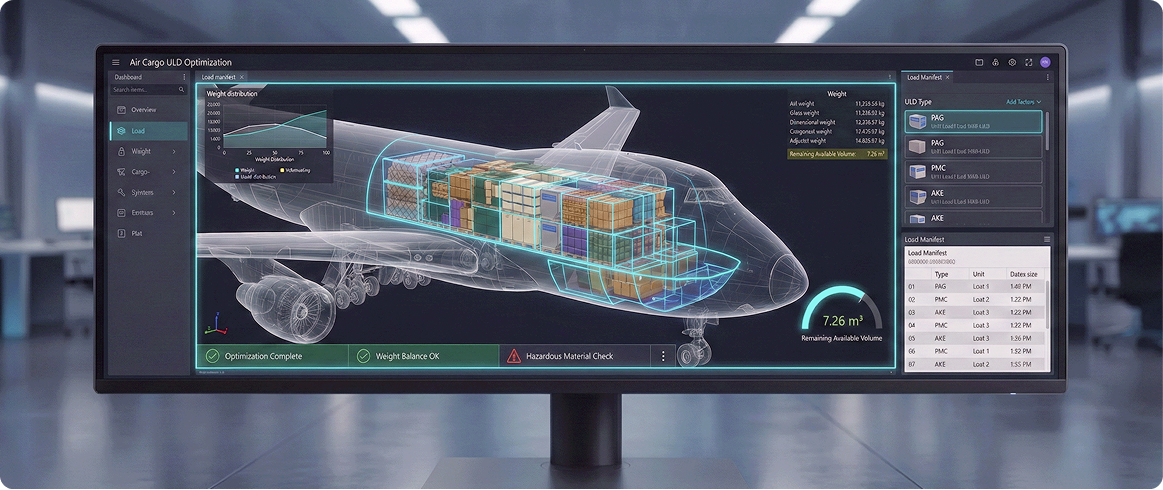
3D ULD
This solution enables the creation of optimal 3D loading plans for shipments and ULDs.
01
Contour measurement (VOLUME)
This solution, operating via mobile devices, digitally creates cargo contour schemes using AR and LiDAR technologies. Cargo compatibility with aircraft can be instantly and visually verified without manual measurement or physical inspection. By transforming the contour process into a fully digital, end-to-end experience, it accelerates operations through faster decisions, fewer surprises, and a clear, error-free loading flow.
Objectives

Operational excellence

End-to-end digital control

Corporate measurement standardization
Benefits

Error-free and safe loading

Smooth and uninterrupted operations

Smarter capacity utilization

02
Autonomous mobile robots (AMR)
Autonomous vehicles operating in warehouse and apron areas enhance operational quality, safety, flow, and predictability. By automating repetitive transportation tasks, they optimize time and resource utilization while improving service quality and enabling teams to focus on more critical, value-added work.
Objectives

Increased operational efficiency

Automation of manual processes

Enhanced field safety
Benefits

Uninterrupted operational flow

Optimized resource utilization

Safer working environment
03
3D ULD
This solution enables the creation of optimal 3D loading plans for shipments and ULDs.
Objectives

Intelligent planning capability

AI-supported decision-making

Operational visibility and clarity
Benefits

Accurate and reliable data

Maximum capacity contribution

More predictable operations
Logitech ecosystem
Terminal venture acceleration program
The Logitech Ecosystem is a sustainable collaboration environment designed to deliver stronger technology-driven responses to critical needs such as speed, cost, and visibility in air cargo and logistics. Within this ecosystem, the discovery and evaluation of logistics-focused startups, identification of priority problem areas, solution validation through pilot/POC implementations, and development of scalable collaboration models are supported. This approach accelerates the deployment of innovative solutions into operations, strengthens partnerships driving industry transformation, and creates an effective platform where startups connect with the right institutions, resources, and opportunities.
145+
Application Received
45+
Met with Startups
Within the venture acceleration program conducted with Turkish Cargo

16 Startups

20 PoCs

Procurement and investment activities